



When the road changes unexpectedly, the destination may still be wealth creation.
Taking a leaf from the epic Ramayan, many of its most difficult moments eventually became turning points. The deeper message is that adversity does not necessarily create opportunity; it can reveal opportunities that were hidden within it.
A powerful story to weave around this is Ram’s exile.
When Ram was asked to leave Ayodhya and spend 14 years in the forest, it appeared to be one of the greatest adversities of his life. He was the rightful heir to the throne, just moments away from becoming king. Yet, instead of resisting, blaming Kaikeyi, or questioning his fate, Ram accepted the situation with composure.
What appeared to be the loss of a kingdom became an opportunity to discover his larger purpose.
The forest was not merely a place of exile for Ram, but he understood the struggles of the people, formed powerful alliances, and ultimately met the circumstances that led him towards his confrontation with Ravan. His relationships with Hanuman and Sugriva, along with his alliance with the Vanar army, emerged during this period of adversity. Had Ram remained in Ayodhya, these relationships and perhaps the larger purpose of his journey may never have unfolded in the same way.
Similarly, in the history of every market correction, whether driven by an economic slowdown or specific events, has been temporary in nature. Investors who remained disciplined and stayed invested over the long term have consistently been rewarded.
Even those who invested at market peaks have generated positive returns when they maintained a long-term perspective.
Market corrections, therefore, need not always be feared. Instead, they can be viewed as valuable opportunities to invest further and accumulate more units or shares at relatively attractive valuations.
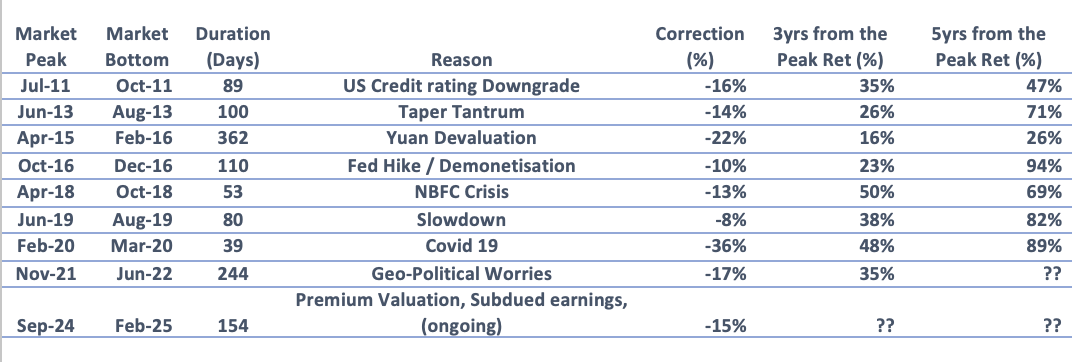
The above chart is essentially telling a story of adversity creating opportunity in equity markets. It fits very well with the Ramayan story.
The table captures major market correctionsand then asks a very important question:
What happened to an investor who had the courage to invest when the market was going through adversity?
Each row has three key elements:
- The adversity – What caused the market to fall. The reasons were different, but the pattern was remarkably similar.
- The magnitude and duration of the fall – How much the market corrected and how long it took to reach the bottom.
- The opportunity that followed - What an investment made at the previous market peak eventually returned over three and five years.
For Example:
Take Covid-19: The market fell 36% in just 39 days, one of the sharpest corrections in the table. At that point, the environment looked extremely uncertain.
Yet, an investor who had invested at the February 2020 market peak and simply remained invested generated approximately 48% return over three years and 89% return over five years.
But there is an even more important message.
The table actually makes a conservative case for investing during corrections. Why?
Because the three-year and five-year returns shows from the previous market peak, not from the market bottom.
Imagine an investor who had the courage to deploy additional money during the correction rather than waiting for the market to recover.
That is where the concept of “Opportunity in Adversity” becomes powerful.






.svg)
.webp)
.webp)
.png)
.svg)

.svg)
.svg)
.svg)